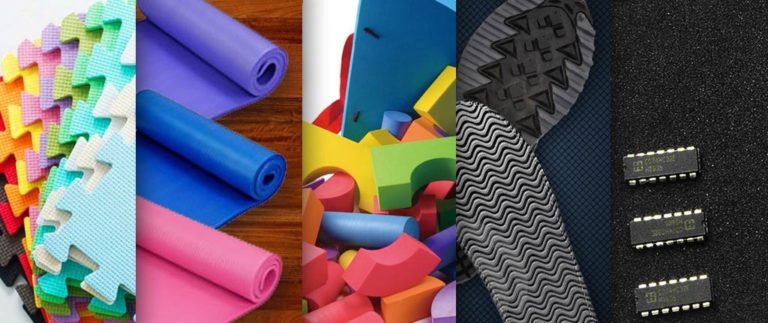
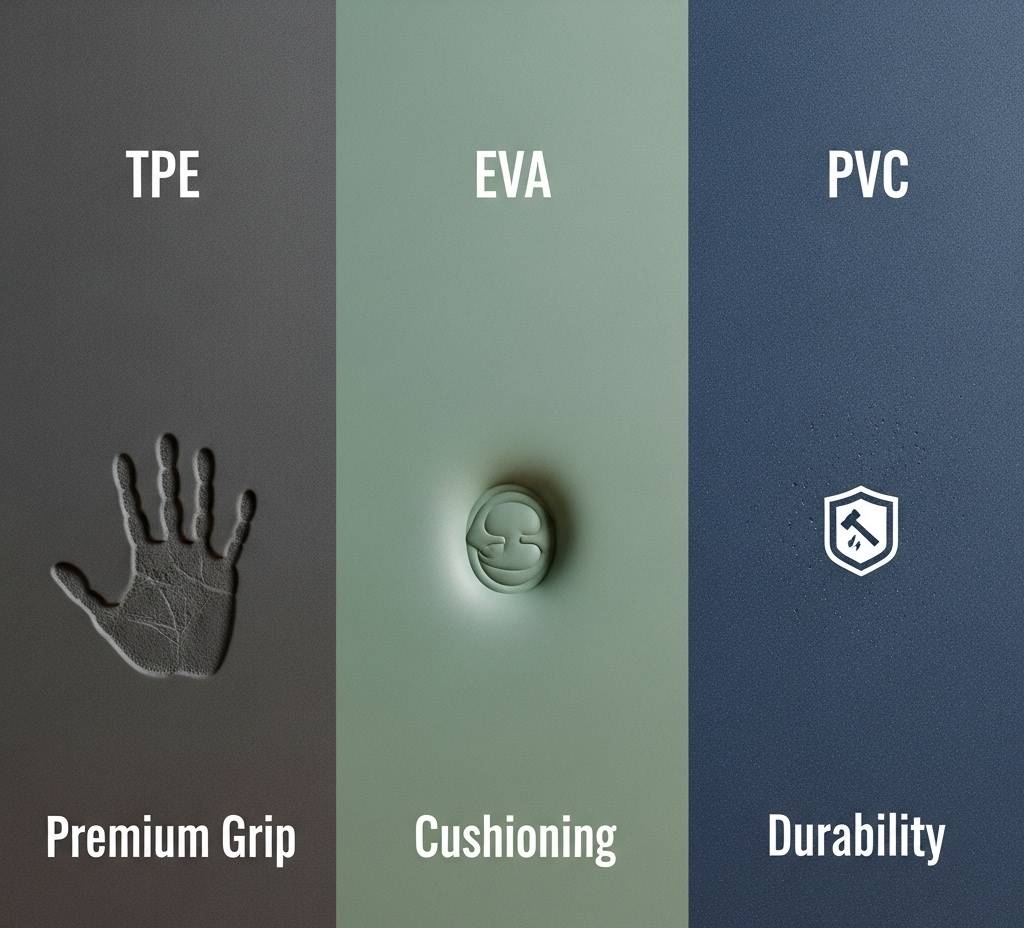
Your material selection can make or break your mat business. TPE offers premium performance and eco-friendliness, EVA delivers safety and affordability, while PVC provides cost leadership despite growing environmental concerns. This decision affects everything from manufacturing costs to brand positioning in a $17+ billion global market growing at 5-7% annually.
The numbers tell a compelling story: 68% of European consumers now prioritize eco-friendly materials, while manufacturing costs range from $700 per metric ton for PVC to $6,500 for TPE. Add regulatory restrictions on PVC expanding worldwide, and material selection becomes a strategic business decision that can’t be left to chance.
Understanding Each Material’s Core Properties
TPE: The Premium Performance Leader
TPE stands out for its exceptional flexibility and grip. This material achieves tensile elongation up to 1,100% while maintaining strength between 450-2,000 psi. The compression set resistance ranges from 10-35% at 73°F, making it incredibly durable under repeated stress.
What sets TPE apart is its slip resistance. In wet conditions, TPE performs five times better than PVC, making it the go-to choice for safety-critical applications. The Shore A hardness ranges from 45-75, allowing manufacturers to fine-tune flexibility for specific uses.
TPE also wins on sustainability. It can be recycled multiple times without losing its properties, and bio-based variants now achieve 45-80% renewable content. This combination of performance and environmental responsibility explains why premium brands charge $120-180 for TPE-based products.
EVA: The Balanced Choice
EVA excels where cushioning matters most. Its foam structure provides superior impact protection and energy absorption. At 0.91-0.95 g/cm³, EVA creates lighter mats than PVC while offering excellent shock absorption.
The material’s Shore A hardness (25-60) varies with vinyl acetate content, giving manufacturers flexibility in design. EVA provides three times better cushioning than rigid alternatives, making it perfect for exercise mats and protective equipment.
Safety is EVA’s strongest selling point. Formamide-free EVA formulations meet strict EU safety standards, making them ideal for children’s products. Bio-based EVA from sugarcane even delivers carbon-negative production, capturing 2.1 kg of CO2 per ton produced.
PVC: The Cost-Effective Workhorse
PVC delivers unmatched durability and chemical resistance. With tensile strength up to 4,000 psi and density of 1.4 g/cm³, it provides stability and dimensional control that other materials struggle to match.
The material resists acids, oils, and cleaning agents up to 60°C, making it practical for harsh industrial environments. PVC also offers the fastest processing times (30-60 seconds for injection molding) and highest yields (96-99%), keeping manufacturing costs low.
However, PVC has significant drawbacks. It becomes slippery when wet, lacks cushioning properties, and faces mounting environmental pressure. The material contains potentially harmful phthalates and releases toxic compounds when burned.
Market Trends Shaping Material Demand
The Sustainability Revolution
Consumer preferences are shifting fast. In Europe, 68% of buyers prefer eco-friendly materials, compared to 47% in North America. This trend creates distinct market segments with different willingness to pay for sustainable options.
Premium eco-conscious consumers drive TPE adoption, paying $120-180 for products with strong environmental credentials. Safety-focused families choose EVA for children’s products, accepting moderate premiums of $50-100. Budget-conscious buyers still prefer PVC despite environmental concerns, but this segment is shrinking.
The yoga mat market alone represents $13.67 billion in 2023, growing to $26.9 billion by 2032. Anti-fatigue mats add another $2.6 billion opportunity. Material market shares reflect these changing preferences, with PVC maintaining 38.7% share but facing declining adoption.
Regulatory Pressure on PVC
PVC faces increasing restrictions globally as regulators classify it among “worst of worst” materials. Major brands commit to PVC elimination by 2025-2030, creating urgent demand for alternatives.
The material’s production involves vinyl chloride, a known carcinogen, and releases toxic dioxins when burned. These health and environmental concerns drive regulatory action across multiple markets.
Certification requirements become competitive advantages. GREENGUARD Gold, OEKO-TEX Standard 100, and REACH/RoHS compliance increasingly influence purchasing decisions. TPE and EVA achieve these certifications more easily than PVC.
Manufacturing Economics and Cost Analysis
Raw Material Costs Tell Only Part of the Story
PVC costs $700-900 per metric ton, EVA ranges $1,500-2,000, and TPE commands $6,000-6,500. These raw material differences seem stark, but total cost analysis reveals more nuanced economics.
TPE offers 100% regrind capability without degradation, potentially offsetting higher raw material costs in high-volume production. PVC achieves fastest cycle times and highest yields, while EVA provides moderate processing efficiency with good foam capabilities.
Volume economics create distinct breakpoints. PVC dominates low-volume production (1,000-10,000 units) at $2.50-4.00 per unit total cost. EVA becomes competitive in medium volumes (10,000-100,000 units). TPE’s recyclability advantages emerge in high-volume applications (100,000+ units) where material reuse matters.
Supply Chain Considerations
TPE shows the highest price volatility (±15-20% annually) due to concentrated Asian supply. EVA faces moderate volatility from solar industry competition for the same base materials. PVC provides the most stable pricing with established global supply chains.
Capital investment requirements vary by processing method. Calendering lines for PVC cost $300,000-2 million but excel for high-volume sheet production. TPE and EVA work efficiently with standard thermoplastic equipment costing $120,000-800,000.
Strategic Positioning Based on Material Choice
Premium Brand Positioning
Brands like Manduka PRO and Liforme leverage superior materials for lifetime guarantees and sustainability messaging. This segment tolerates higher costs for performance and environmental benefits, making TPE’s premium pricing acceptable.
Premium positioning demands materials that support strong brand narratives. TPE’s combination of performance, sustainability, and regulatory compliance enables premium pricing and customer loyalty that justifies the higher material costs.
Safety-Focused Family Positioning
Parents prioritize safety over cost when choosing products for children. Formamide-free EVA targets this segment effectively, enabling moderate premiums in the $50-100 product range.
This positioning works particularly well for children’s play mats, exercise equipment, and educational products where toxic exposure concerns override cost considerations. Safety certifications become powerful marketing tools.
Value-Performance Positioning
EVA or PVC can both support value positioning, depending on specific performance requirements. EVA works well for cushioning-focused applications, while PVC suits durability-focused commercial uses.
Both materials enable competitive pricing in the $20-60 range while offering distinct performance advantages. The choice depends on primary performance requirements and target customer priorities.
Application-Specific Performance Requirements
Where Each Material Excels
Anti-fatigue and cushioning applications demand EVA’s superior energy absorption. The material’s foam structure and buoyancy characteristics excel in workplace safety, exercise mats, and protective equipment.
Non-slip and safety applications require TPE’s grip performance. The material’s coefficient of friction varies inversely with hardness, allowing optimization for specific conditions. TPE’s wet-weather performance makes it essential for bathroom mats and pool areas.
Heavy-duty commercial uses benefit from PVC’s durability and chemical resistance. Despite environmental concerns, PVC’s resistance to harsh chemicals and superior tear strength make it practical for industrial environments.
Temperature and Environmental Factors
Temperature considerations significantly impact material selection. TPE-V variants withstand continuous service to 120°C, EVA typically operates from -40°C to +70°C, and PVC flexible grades vary with plasticizer selection but generally limit to 60°C.
UV stability matters for outdoor applications. EVA provides excellent UV radiation resistance, TPE offers good stability in many formulations, while PVC requires specialized stabilizers for extended outdoor exposure.
Future-Proofing Your Material Strategy
Preparing for Regulatory Changes
Regulatory trends strongly favor sustainable alternatives as PVC faces increasing restrictions globally. Mat manufacturers need transition strategies to avoid market disruption as environmental regulations tighten.
Major customers increasingly eliminate PVC from approved supplier lists. Companies that wait too long to develop alternatives risk losing access to key markets and distribution channels.
Bio-Based Material Development
Bio-based TPE and EVA variants from renewable feedstocks are becoming commercially viable. Early adoption provides competitive advantages as sustainability requirements intensify and carbon footprint becomes a key differentiator.
Circular economy initiatives create new value streams through take-back programs, recycled content integration, and material passport systems. TPE’s superior recyclability positions it advantageously for these emerging requirements.
Making the Right Choice for Your Brand
The material you choose defines your brand positioning, target market access, and long-term competitiveness. Here’s how to approach this critical decision:
For premium positioning, TPE provides the best combination of performance, sustainability, and regulatory compliance. Despite higher costs, it enables premium pricing, lifetime guarantees, and environmental messaging that resonates with growing eco-conscious segments.
For safety-focused positioning, formamide-free EVA offers optimal balance of safety credentials, performance, and cost-effectiveness. This approach works well for children’s products and family-oriented brands where safety concerns justify moderate price premiums.
For cost-sensitive applications, consider strategic PVC use in appropriate applications while developing transition plans. Focus on heavy-duty industrial uses where PVC’s performance advantages remain compelling, but prepare for phase-out.
For future market positioning, invest in bio-based material relationships and circular economy capabilities. Early adoption of renewable feedstock materials and recycling programs creates competitive advantages as sustainability requirements intensify.
The material decision ultimately determines your brand’s future in an industry where environmental responsibility and performance excellence are no longer optional – they’re the price of admission to tomorrow’s market.
References and Additional Resources
- Grand View Research – Yoga Mat Market Size Report – Comprehensive market analysis and growth projections
- Data Bridge Market Research – Global Yoga Mat Market – Industry trends and material segmentation data
- RTP Company – TPE Product Selection Guide – Technical specifications and performance characteristics
- Curbell Plastics – EVA Material Properties – Detailed EVA technical data and applications
- Teknor Apex – The Recyclability of Thermoplastic Elastomers – Sustainability and recycling information
- WasteTrade – EVA Recycling Guide – Environmental impact and recycling processes
- Polaris Market Research – Yoga and Exercise Mats Market – Market trends and consumer preferences
- FKUR – Bio-based EVA Materials – Sustainable material innovations
- HEXPOL TPE – Sustainable TPE Solutions – Advanced TPE formulations and applications
- I Read Labels For You – Yoga Mat Safety Analysis – Health and safety considerations for mat materials
For more information about foam and mat manufacturing solutions, visit Supreme Foam’s product.